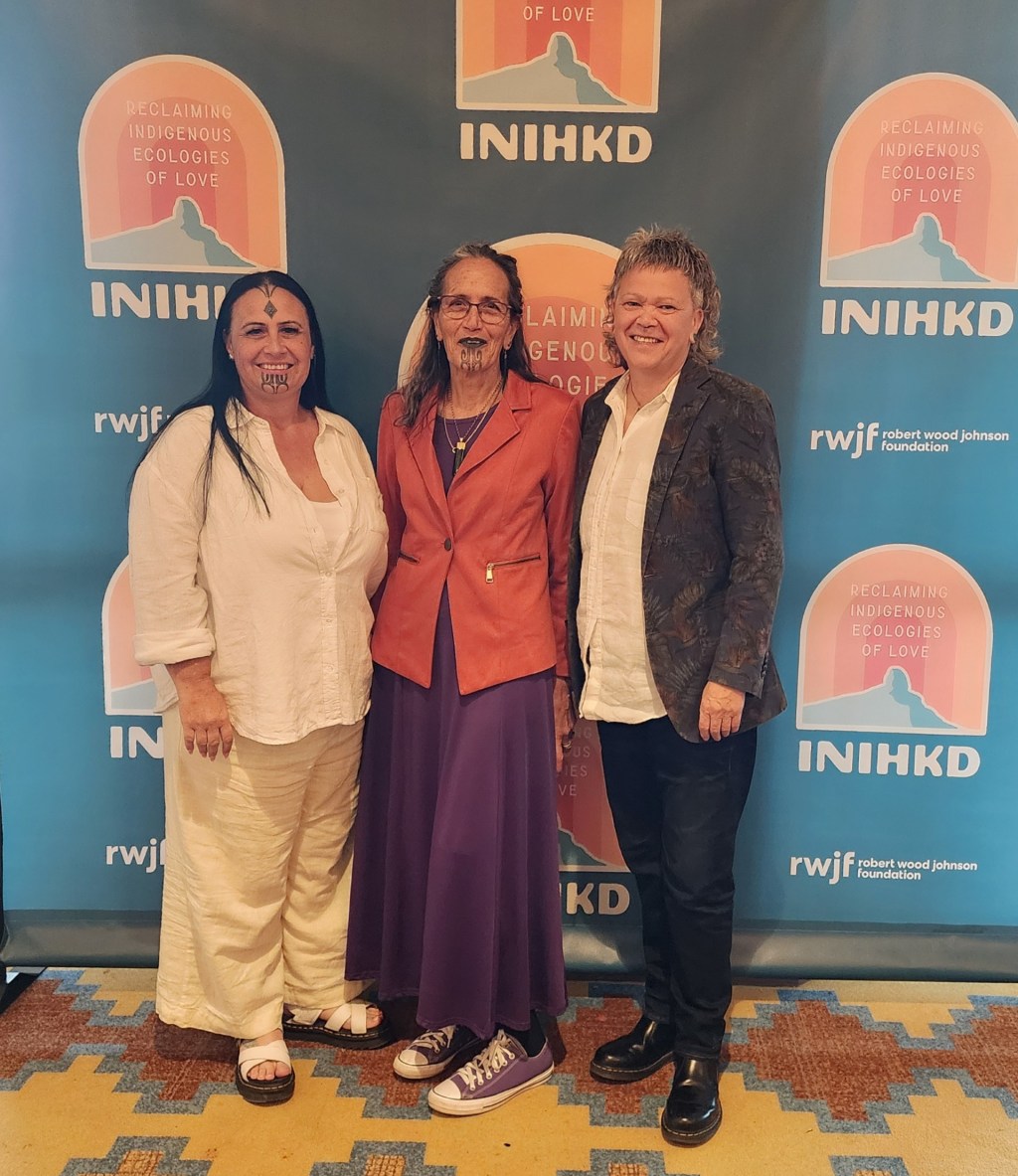
Sacred Pueblo Maunga – Rising Ancestors
The parallels between Indigenous experiences across the world became immediately apparent – the shared histories of colonisation, the similar struggles for recognition, and the common understanding that healing must come from within our own knowledge systems and “ecologies of love.”
It was within this ancestral landscape that Te Whāriki Manawāhine O Hauraki presented our research at the International Network of Indigenous Health, Knowledge and Development Conference. We centred the voices of wāhine from gang whānau and takatāpui communities, voices that too often go unheard in Aotearoa. The response was powerful. A keynote who attended this presentation remarked in a shocked emotional voice: “Why did I have to come halfway around the world to actually hear the voices of these wāhine?” Our reply was simple: “Because no one at home will listen.”
This highlights a concerning pattern in research relationships today – one that became increasingly apparent as the beauty of our surroundings contrasted with troubling dynamics within our own research communities.
Voices from the Margin of the Margins
Both research projects we presented stemmed from years of working alongside the Abuse in Care Royal Commission and survivors of state and faith-based abuse. Our first presentation, “Ki ō Mātou Ake Kupu: Wāhine from Gang Whānau Healing Intergenerational Trauma through Traditional Practices,” reflected three essential elements of our mahi: the researcher perspective (myself), the healer’s wisdom (Denise Messiter), and participant leadership (research participant Paula Ormsby, leader of the Wāhine Toa Chapter of the Mongrel Mob Kingdom).
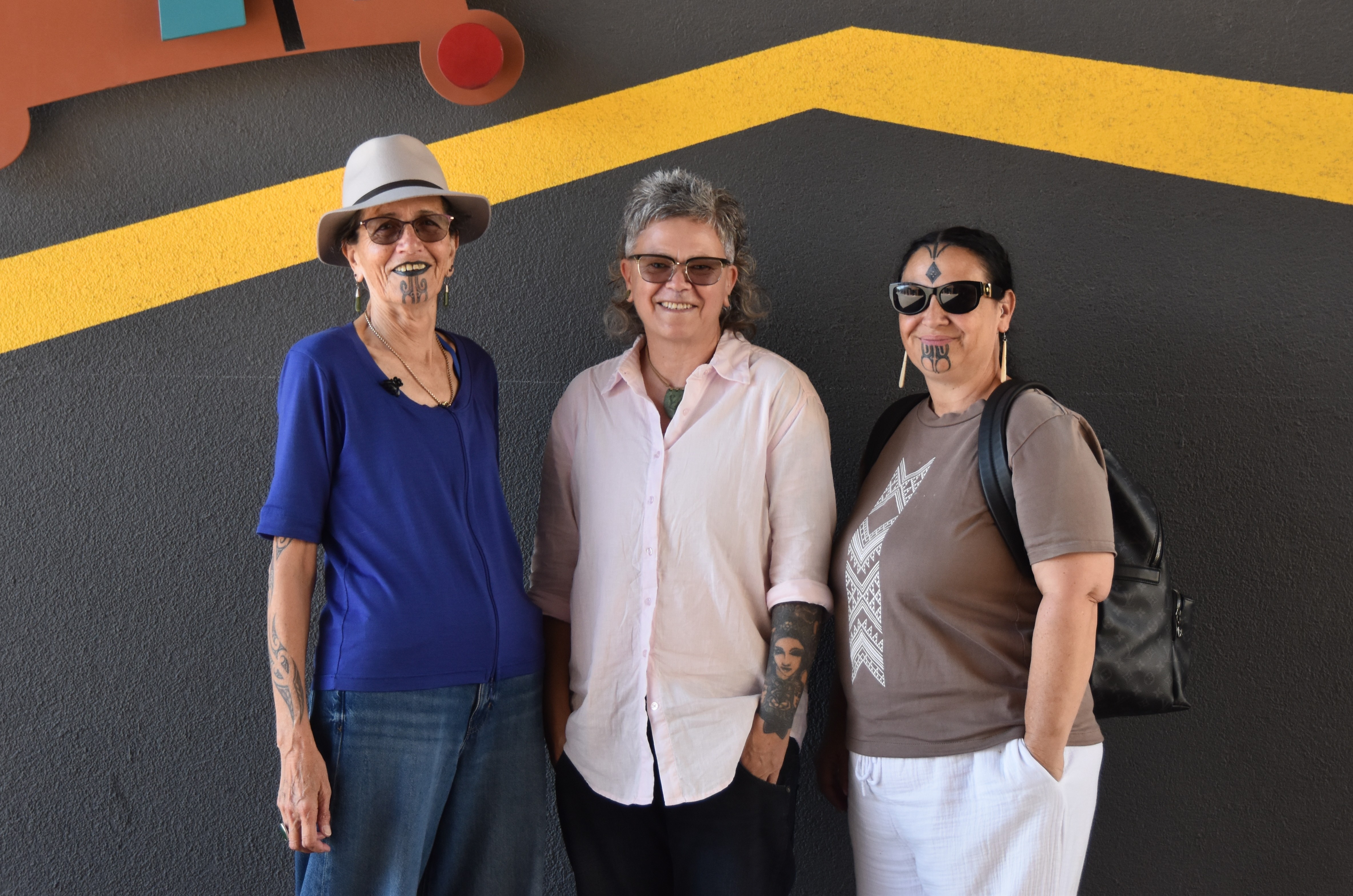
Ki ō Mātou Ake Kupu: Wāhine from Gang Whānau Healing Intergenerational Trauma through Traditional Practices
The Abuse in Care Royal Commission revealed that 80-90% of Māori gang members experienced abuse in state care. This trauma drove many tāne Māori to seek connection and protection within gang communities. Yet the Commission’s work did little to acknowledge wāhine as legitimate members of gang whānau, despite being integral to them.
This ongoing gang wāhine research received Health Research Council funding after we applied, driven by our dissatisfaction with the Royal Commission’s failure to recognise wāhine as gang whānau and provide them with a voice. This funding represents a significant milestone: it’s the first time the HRC has awarded an “Emerging Researcher First Grant” to a researcher in a community group, and the first time a project centring wāhine from gang whānau has received this level of institutional support.
Denise Messiter, designer/facilitator of the Te Ara PouTama and PouHine wānanga, spoke to the legitimacy of Indigenous healing methods. The PouHine reconnects wāhine Māori to their ancestral voice using sound techniques that extend beyond formal karanga, allowing them to reclaim their narratives. “We’ve been doing this work for 25-30 years,” Messiter explained, “longer than many participants have even been alive. Our method shows that Hauraki healing practices have real, measurable impact and that they work across all our communities.”
The gang whānau leadership Te Whāriki have been working with maintains that healing must come from within. These wāhine are creating their own solutions through Te Ara PouHine wānanga, delivering a clear message: “We define who we are.”
Indigenous keynote speakers and leading researchers from around the world attended our session and heard Ormsby state: “The PouHine saved my life.” Her kōrero was powerful, raw, and visibly moved the room. The response from session attendees confirmed for us that our mahi is key.
Our second presentation built on this foundation, focusing on another marginalised community within our communities. “As A Kid I Always Knew Who I Was” emerged from independent research for the Abuse in Care Royal Commission, centring the voices of takatāpui, Rainbow, and MVPFAFF+ survivors who had been similarly overlooked.
As A Kid I Always Knew Who I Was: Reclaiming Indigenous Systems of Care for Takatāpui, Rainbow, and MVPFAFF+ Communities
For the takatāpui voices project, the Commission eventually acknowledged its failure to adequately engage with takatāpui, Rainbow and MVPFAFF+ communities and supported the “As a Kid I Always Knew Who I Was” research. Takatāpui is the te reo Māori term for intimate companion of the same sex, while MVPFAFF+ represents Pacific Rainbow communities.
A key aspect was survivors’ call to reclaim their traditional roles as caregivers – roles that settler-colonial systems actively deny them through homophobia and transphobia. These systems simultaneously remove tamariki from their communities while preventing takatāpui from fulfilling their natural caregiving roles. As one survivor stated: “We are naturally carers. We looked after our whānau, our tamariki and kaumātua before the colonials descended upon us.”
The response to this presentation was equally powerful. Two-spirit researchers approached me following our takatāpui presentation. One shared, “I was a stolen child and like you it informs everything I do for my community,” while another confided, “I really needed to come to this, our trans community are getting hammered right now.” These connections highlighted how our struggles in Aotearoa resonate across Indigenous communities globally.
What made our approach distinctive was how we honoured the complete existence of our communities – not just their pain but their mana, creativity, and solutions. Instead of positioning our communities as defined by their trauma, we focused on their strength and the liberation pathways designed by and for those most affected.
Past, Present and Future All One Time, No Time
We intentionally structured our kōrero to transcend conventional trauma-centred narratives. The sequence began with research context and my (Paora) lived experience of stolen generations, then moved to Denise’s exploration of traditional and vibrational sound methods, before finally highlighting the whakapapa of participant’s lived reality.
Our approach showed how trauma was ongoing – past still present and future. This was structured within the Pū Rā Ka Ū framework. Ka meaning past, present and future are all one time and no time, connected without fraction. The critical difference in our mahi is that our communities define their own trauma, their own healing pathways, and in their own words. This positions them not as research subjects but as knowledge holders and experts in their own lived experiences.
Framed within the context of colonisation and the ongoing dominance of Western systems in Aotearoa, our work offers tangible liberation strategies designed by those most affected. When Paula Ormsby stated “The PouHine saved my life,” she wasn’t speaking as a research subject but as a leader defining her own narrative of healing and transformation.
In rejecting conventional academic methods, our research team centres lived experience as knowledge. Our presentations did not rely on high-tech visuals. We trusted in the power of waha pikitia and storytelling, elevating voices that have long been ignored. The transformed lives of participants demonstrate that our healing practices work.
Ongoing Struggles, Not Historical Events
The connection to the Royal Commission matters because these same groups continue to be marginalised today. Wāhine seeking help from family violence are still being turned away from refuges because of their gang connections. Our trans and non-binary whānau face renewed political attacks through efforts to legally define gender in biological terms, threatening their traditional caregiving roles.
State-imposed trauma isn’t historical. It continues now. Yet at the conference, there seemed to be a reluctance to address Aotearoa’s ongoing systemic issues, with many preferring to skip straight to discussions of “love” without acknowledging the persistent pain.
While the conference promoted “ecologies of love,” back home the political landscape has become increasingly hostile. New Zealand’s right-wing coalition government has pledged closer relations with overseas administrations, systematically undoing progressive initiatives. As I write this, the NZ Government is forcing through Parliament a bill that halts all current pay equity claims and makes it harder to lodge new ones. That impacts Aotearoa yet again – low paid wāhine who already carry the burden of colonial violence and stupid men.
A Contradiction in “Ecologies of Love” and Selective Narratives
There’s a contradiction in talking about “ecologies of love” while maintaining traditional academic power structures. When community researchers pay thousands to present our work – the same amount as established academics supported by their institutions – we earn our place on that stage. Yet we received no formal feedback when we asked for it. When some researchers became interested in our community participants, they approached them directly rather than engaging with the research team that had spent two years building trust and creating safety.
At the conference, I attended a presentation by another research team discussing a national housing project that had contracted Te Whāriki Manawāhine O Hauraki. In their presentation, our findings weren’t mentioned. Nothing about land access challenges in Hauraki. Nothing about Auckland holiday home buyers affecting local whānau. Nothing about people living in vehicles in the mangroves.
Instead, what we saw was the romanticisation of Māori concepts – sanitised versions of “home” and “belonging” that ignored the brutal realities of dispossession that Hauraki whānau face every day. The raw data we provided about homelessness, about tamariki sleeping in cars, about the takeover of our lands by wealthy outsiders, about elderly leaving their papakāinga due to rates increases – all of this was erased in favour of palatable, abstract discussions.
“If You Can’t Tell the Whole Truth, You Side with the Oppressors”
To create genuine ecologies of love, we must speak the whole truth. We cannot divide healing from harm, light from darkness, or love from pain. These elements exist in relationship to each other.
As Paulo Freire taught us fifty years ago and as I said at the conference: “There is no such thing as neutrality in this work. If you can’t tell the whole fecking truth, you side with those who control the narrative, the oppressors.”
When researchers choose comfortable narratives over uncomfortable realities, they are not being neutral – they are actively participating in oppression.
Community expertise stands on its own merit. In rejecting conventional academic methods, our research team centres lived experience as knowledge. We trusted in the power of Waha Pikitia (visual storytelling) rather than high-tech visuals, elevating voices that have long been ignored. The transformed lives of participants demonstrate that our healing practices work.
To truly create ecologies of love, we need shared power, platforms, funding, and credit. This means research projects co-designed with community members as equal partners, paid at the same rates as academics. It means findings presented jointly, with community members speaking in their own voices, and publication credits that recognise community expertise alongside academic credentials. Most importantly, it means community approval of how research is framed before it’s shared publicly.
Reclaiming Indigenous Ecologies of Love
True Indigenous ecologies of love look like wāhine from gang whānau defining their own healing journeys through PouHine wānanga. They look like takatāpui reclaiming their roles as natural caregivers and knowledge holders. They look like communities setting their own research agendas and speaking on international stages.
They look like research that elevates rather than extracts. Academic institutions paying community researchers as equals. Findings that include brutal realities alongside beautiful solutions. Government policies that support pay equity rather than dismantling it. Refuges that welcome wāhine regardless of their whānau connections.
Our presence at this international forum represented seven years of work alongside survivors of state care, developing community-led solutions that continue well beyond any conference. Only by ensuring the most silenced have both the stage and the power to define their own narratives can we move from rhetoric to reality.
By Paora Moyle, Director of Research, Te Whāriki Manawāhine O Hauraki
 POUHINE
You must be logged in to post a comment.