Framing Statement
In this account, I use the Pū Rā Ka Ū framework at two levels; to organise the writing and to show how we have applied it in our research. This demonstrates the framework’s versatility across individual projects and broader approaches.
PŪ (Origin): A Kaupapa Māori Research Framework
Over the last few years, our research at Te Whāriki Manawāhine O Hauraki has adapted and implemented the Pū-Rā-Ka-Ū framework (Wirihana, 2012). This Kaupapa Māori approach has reshaped how we understand and address complex social issues affecting Māori communities in Hauraki by elevating marginalised voices and creating pathways for community-led change.
Origins and Development of the Framework
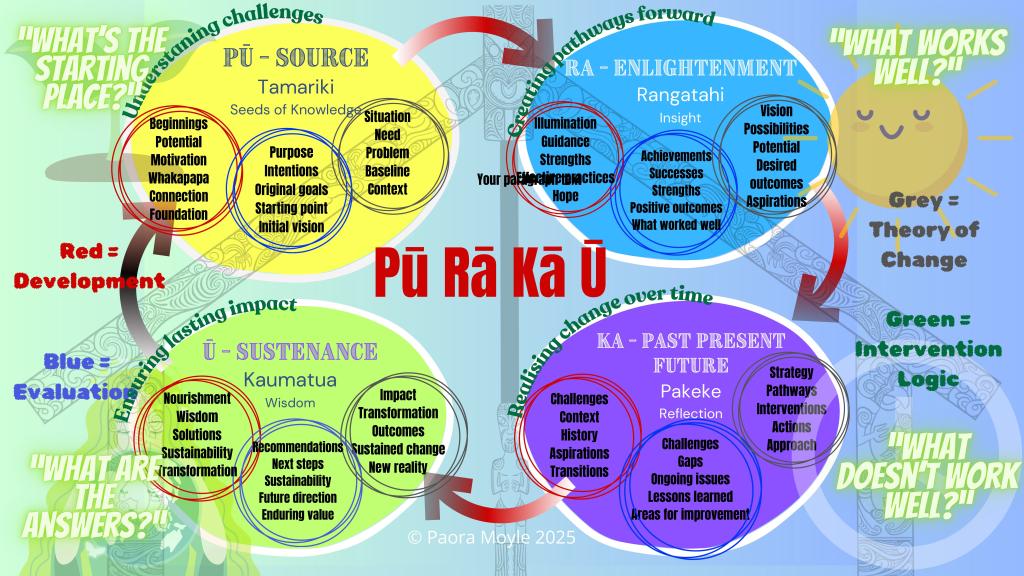
From Wirihana’s (2012) original work, I adapted/developed the Pū-Rā-Ka-Ū framework to meet our need to decolonise research methodologies and create approaches that truly reflect the lived experiences of Hauraki Māori communities. Drawing inspiration from traditional knowledge systems, like a film reel, each frame ensures that research not only documents experiences but also generates transformative action.
The name carries a deeply rooted significance, with each component representing essential elements within the cycle of knowledge and growth:
• Pū (Source/Origin): Represents the seed or beginning point, the tamariki phase, where potential and possibility exist. This component explores the origins of knowledge, leadership, and connection to whakapapa, examining the motivations that drive people to care for one another and the cultural foundations that underpin resilience strategies.
• Rā (Enlightenment): Embodies the rangatahi phase, where light illuminates knowledge and experiences that guide and sustain. This element explores existing effective practices, successful strategies, and positive outcomes that emerge from challenges.
• Ka (Past, Present, Future): Reflects the pakeke phase, examining how historical and contemporary experiences inform future aspirations. This component identifies challenges in current approaches while considering their context and implications.
• Ū (Sustenance): Symbolises the kaumātua phase, representing the nourishment and wisdom that comes from within. This element offers practical, sustainable approaches and recommendations for improving systems and responses.
The framework functions both linearly and cyclically, with the wisdom gained in the Ū phase nourishing new beginnings in the Pū phase, creating a continuous loop of learning, growth, and transformation.
RĀ (Enlightenment): Applications Across Research Projects
Pū (Origin) in Practice
In the “He Whare, He Taonga” study, Pū revealed how ‘kāinga’ serves as more than just a physical space for Hauraki wāhine Māori; it embodies belonging, protection, and stability. As one participant stated, “Home is a place to be and belong, surrounded by people you are connected to.”
Similarly, in the Hauraki Māori Weathering Cyclone Gabrielle research, Pū highlighted how intergenerational connections to whānau, whakapapa and whenua motivated Māori communities to mobilise during the disaster. One participant shared, “This is our forever home here on our papakāinga. This is my whenua, I was brought up here in this house. I can’t go anywhere else.”
Rā (Enlightenment) in Practice
In the Takatāpui, Rainbow, and MVPFAFF+ research, Rā highlighted how communities articulated hope through visions for wellbeing and the restoration of mana motuhake. One participant stated,“Give us back our mana motuhake. The Indigenous realm is heavily affected by the way the State and religions have imposed their power, and we must not forget that.”
For Hauraki Māori during Cyclone Gabrielle, Rā revealed that resilience was not merely an inherent trait, but a contextual, collective response shaped by historical, social, and structural factors. While communities demonstrated remarkable ability to support each other, many described this resilience as “driven by necessity” rather than choice.
Ka (Past, Present, Future) in Practice
Across our studies, Ka uncovered “enduring injustices”, ongoing hardships faced by Māori communities as a direct result of historical and contemporary colonial practices. In the He Whare, He Taonga study, participants described a serious housing crisis in Hauraki, where 50% of housing consists of holiday homes, leaving limited options for residents, particularly wāhine Māori and their whānau.
The Hauraki Māori Weathering Cyclone Gabrielle research expanded on these findings, showing how the disaster intensified existing vulnerabilities, forcing many whānau into overcrowded or substandard living conditions. One participant explained, “They’re struggling, and in most cases, living in substandard housing that they just make do with. There aren’t many rental options in Hauraki, and whānau can’t afford to rent anyway.”
Ū (Sustenance) in Practice
In the Takatāpui, Rainbow, and MVPFAFF+ research, Ū captured survivors’ aspirations for transformative change, including the end of State removal of mokopuna Māori. One participant asked, “How many times does the State have to harm children before they can see that they shouldn’t have the power to make decisions for children?”
The He Whare, He Taonga study highlighted papakāinga as a central solution, not only for housing but also for restoring Māori self-determination. One participant shared, “We have whenua, and on that land, there are whakapapa connections: it’s more than a whare. It’s the connection to the whenua, and how we bring about whānau connectivity amongst that landscape.”
KA (Past, Present, Future): Methodological Applications Across Research Projects
He Whare, He Taonga
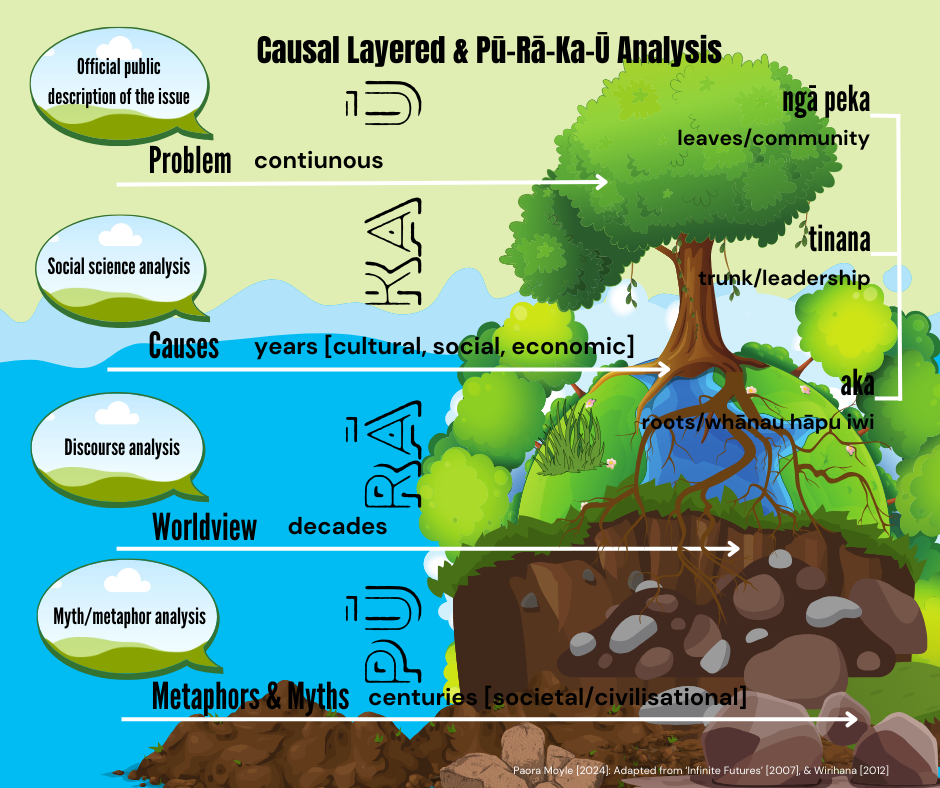
The He Whare, He Taonga study explored the link between family violence and housing poverty for Hauraki wāhine Māori. Using the Pū-Rā-Ka-Ū framework alongside Causal Layered Analysis, the research amplified wāhine voices, revealing how systemic housing disparities perpetuate violence and impede recovery.
The framework organised participants’ kōrero into quotable insights, eliminating researcher interpretation. Wāhine Māori narratives guided the analysis and recommendations, leading to culturally grounded solutions.
Voices of Takatāpui, Rainbow, and MVPFAFF+ Survivors
This research examined systemic harm inflicted on Takatāpui, Rainbow, and MVPFAFF+ communities through State and faith-based institutions. The framework explored identity (Pū), hope (Rā), harm (Ka), and aspirations for change (Ū), keeping survivor narratives central.
Verbatim survivor accounts were preserved, treating pūrākau as taonga and positioning survivor knowledge as fundamental to decolonial transformation.
Hauraki Māori Weathering Cyclone Gabrielle
This research examined how Hauraki Māori mobilised to support whānau during and after Cyclone Gabrielle. Using contrast analysis, the research compared Māori approaches with those of the Thames Coromandel District Council.
The comparison revealed striking differences. Māori responses were grounded in traditional knowledge, community connections, and holistic wellbeing. TCDC’s approach was structured and bureaucratic, often overlooking Māori needs and ecological wisdom.
Diverse Applications of the Pū-Rā-Ka-Ū Framework
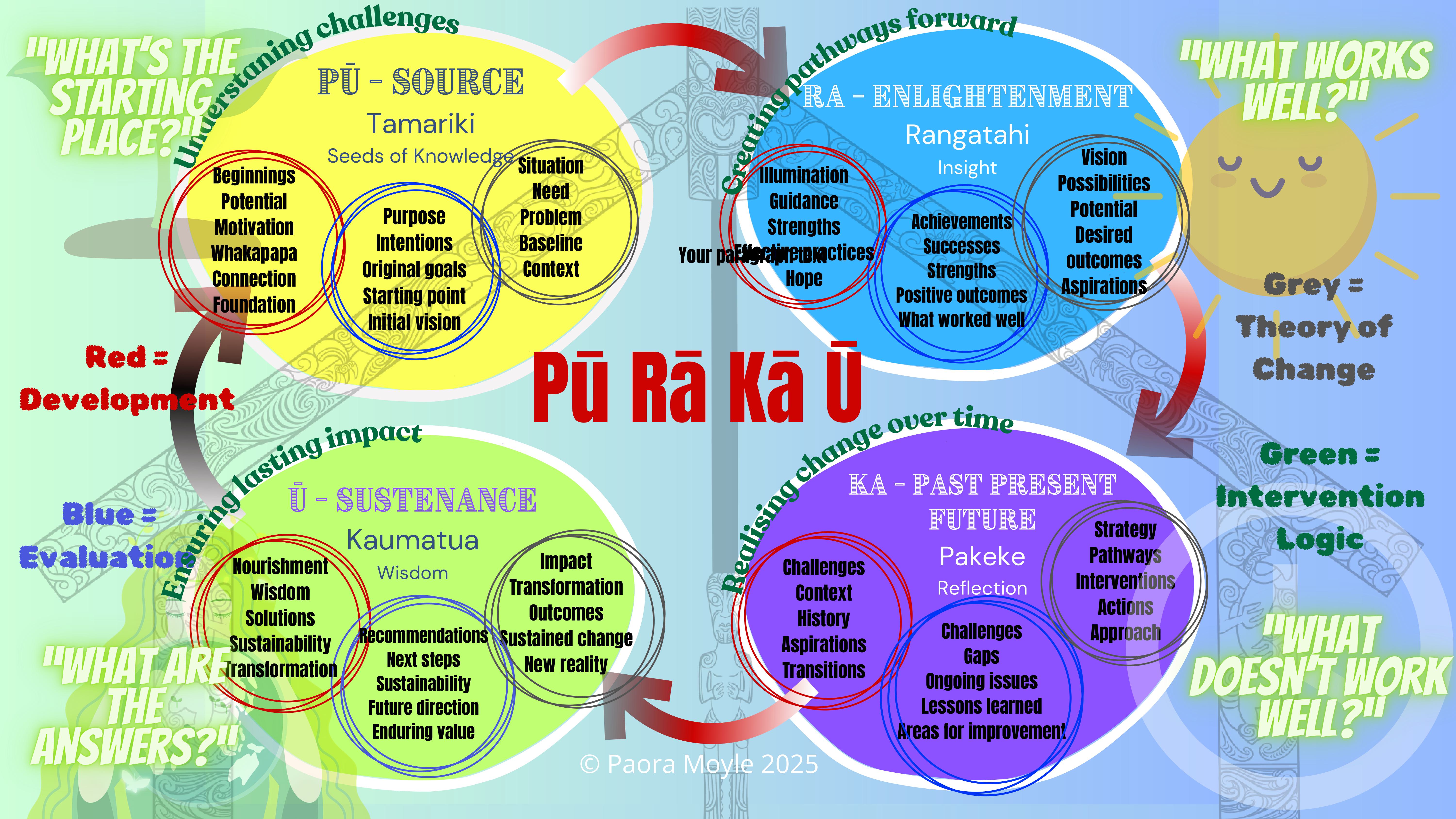
The visual representation shows how the framework applies across multiple contexts, each colour-coded by application type:
Project Development (red) – Explores motivations and whakapapa connections, identifies strengths, acknowledges historical context, and sustains transformation through wisdom-based solutions.
Project Evaluation (blue) – Revisits original purpose to measure progress, highlights what worked well, examines challenges and lessons learnt, and establishes recommendations for sustainability.
Theory of Change (grey) – Understands current situation as baseline, illuminates possibilities and desired outcomes, creates strategic pathways for intervention, and sustains impact toward a new reality.
Intervention Logic (green) – Conducts needs assessments to identify root causes, establishes clear objectives with measurable indicators, implements specific activities, and evaluates long-term impact and sustainability.
Each application answers four fundamental questions: “What’s the starting place?” (Pū), “What works well?” (Rā), “What doesn’t work well?” (Ka), and “What are the answers?” (Ū).
Ū (Sustenance): Transformative Impact and Future Directions
The Pū-Rā-Ka-Ū framework has shaped our research methodology and outcomes in three key ways:
Prioritising Indigenous Perspectives The framework elevates the perspectives of those most affected by incorporating verbatim quotes and validating pūrākau as evidence. This ensures research findings authentically reflect participants’ lived realities and builds pathways for culturally responsive solutions.
Exposing Structural Inequities By examining issues across temporal dimensions and multiple perspectives, the framework uncovers how systemic inequities perpetuate harm and undermine wellbeing in Māori communities.
Facilitating Grassroots Solutions The framework creates space for community-driven approaches rather than external interventions. In the He Whare, He Taonga study, wāhine Māori articulated housing solutions including papakāinga development and wraparound services. In the Cyclone Gabrielle research, participants demonstrated the effectiveness of Māori-led disaster responses rooted in traditional knowledge and community networks.
The framework operates as a continuous cycle, ensuring research generates practical solutions that improve community wellbeing.
Paora Moyle is a Senior Research Felow and Kaihautū Rangahau at Te Whāriki Manawāhine Research, where they have developed and refined the Pū-Rā-Ka-Ū framework to help whānau participate more in research projects.
Wirihana, R. (2012). Ngā pūrākau o ngā wāhine rangatira Māori o Aotearoa: The stories of Māori women leaders in New Zealand. A thesis presented for the degree of Doctor of Philosophy in Psychology, Massey University [Albany, New Zealand]. http://hdl.handle.net/10179/4672
 POUHINE
You must be logged in to post a comment.