“A picture is worth a thousand words”
Many of our people exist on the margins of the margins. The Hauraki Whānau Voices research program emerges as a direct response to this reality, standing as a first for Hauraki and carrying profound importance for countless whānau who have been systematically excluded from conversations that shape their lives.
At Te Whāriki Manawāhine O Hauraki, this research program represents just one dimension of our deep commitment to serving our community. These commentaries document the journey of this work; its challenges, breakthroughs, and transformations, creating a record that honours both the process and the whānau whose voices drive it forward. Through sharing these stories, we aim to contribute to the dismantling of research practices that have historically harmed rather than helped our communities.
To this end, we have been creating, implementing and refining an innovative research methodology called Waha Pikitia, an approach to visual communication that enables marginalised communities to express their lived experiences beyond the constraints of traditional research methods.
The name Waha Pikitia embodies the philosophy that “a picture is worth a thousand words.” But it’s much more than just a tool; it’s a way of thinking, expressing, analysing, and conveying meaning. It recognises the universal language of imagery and challenges us to visualise information in new and innovative ways, acknowledging the power of images in influencing policy, practice, and systems.
This methodology wasn’t born in a theoretical vacuum but emerged organically from work with communities. During our first research project on housing poverty and mahi tūkino, wāhine participants who had tamariki with neurodiverse conditions shared their experiences of discrimination when applying for housing. In their vulnerability, they expressed a desire to “see themselves in the research beyond just a quote”, they wanted more than just receiving a transcript or reading a final written report. Similar feedback came from takatāpui, rainbow, and MVPFAFF+ research participants in work with the Abuse in Care Royal Commission.
Their voices catalysed the development of Waha Pikitia.
The Journey Across Four Research Projects
He Whare, He Taonga Research
The first exploration with Waha Pikitia began during the He Whare, He Taonga research. Some participants struggled to articulate their experiences of significant abuse at home, in state care, and from state agencies that were established to provide them with care and support. The layers of colonial intergenerational trauma they carried made talking about these experiences for the first time immensely courageous.
Good interviews required patience, time, and resources within a limited budget. It also required some thinking about ways to help guide the more difficult conversations with participants.
Reflection on my whakapapa research from 1997 with whānau provided inspiration, where archival maps, sketches of tāniko patterns, and whakapapa manuscripts with handwritten notes that whānau members recognised were used as conversation starters. These visual prompts, along with photos of tāmoko and moko kauae from great-grandparents, created wonder, connection, and enthusiasm for sharing pūrākau (stories).
Recognising the power of imagery to instantly connect people to places, events, history, and themselves, this approach began to be applied in interviews with whānau. They shared stories like the “brown paper bag experience” where the research team, having forgotten whiteboard paper, ended up brainstorming research notes on cut-open brown paper shopping bags. This evolved into what is now called “the brown paper bag approach” in our research methodology.
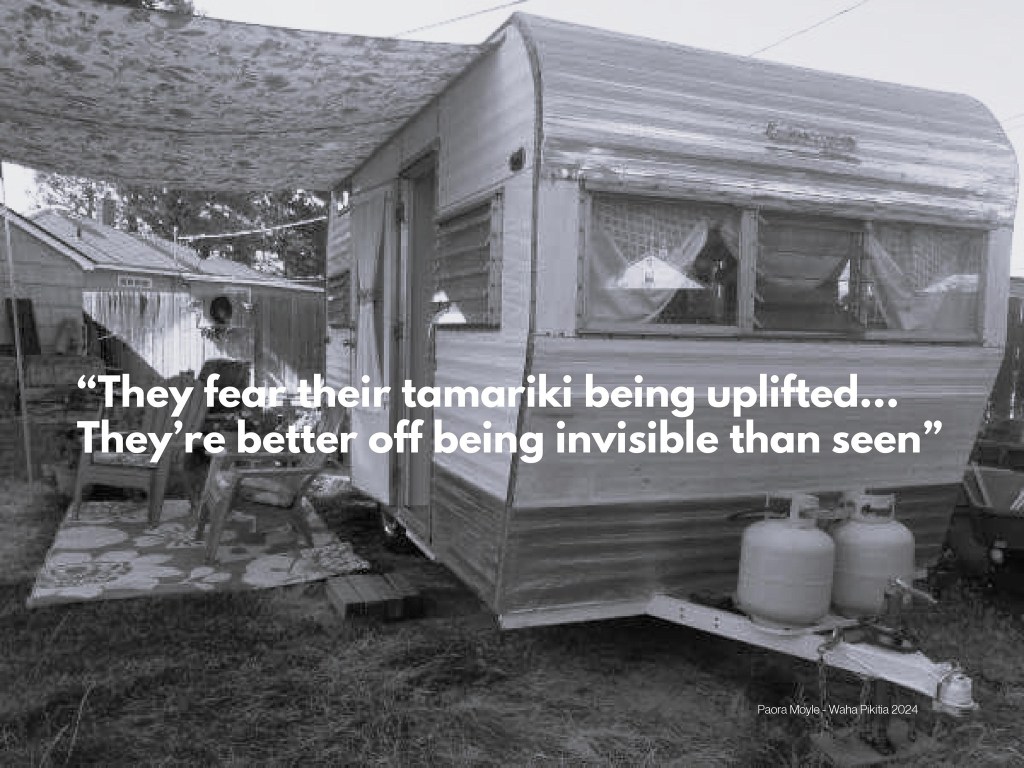
In conversations with whānau, I began using photos of how participants lived houseless in caravans, cars, and in the mangroves around Hauraki. Some photos were taken by the participants themselves, and for others, consent was obtained to capture them. These images were incorporated throughout the He Whare, He Taonga research alongside their written pūrākau, creating a powerful multi-dimensional narrative.
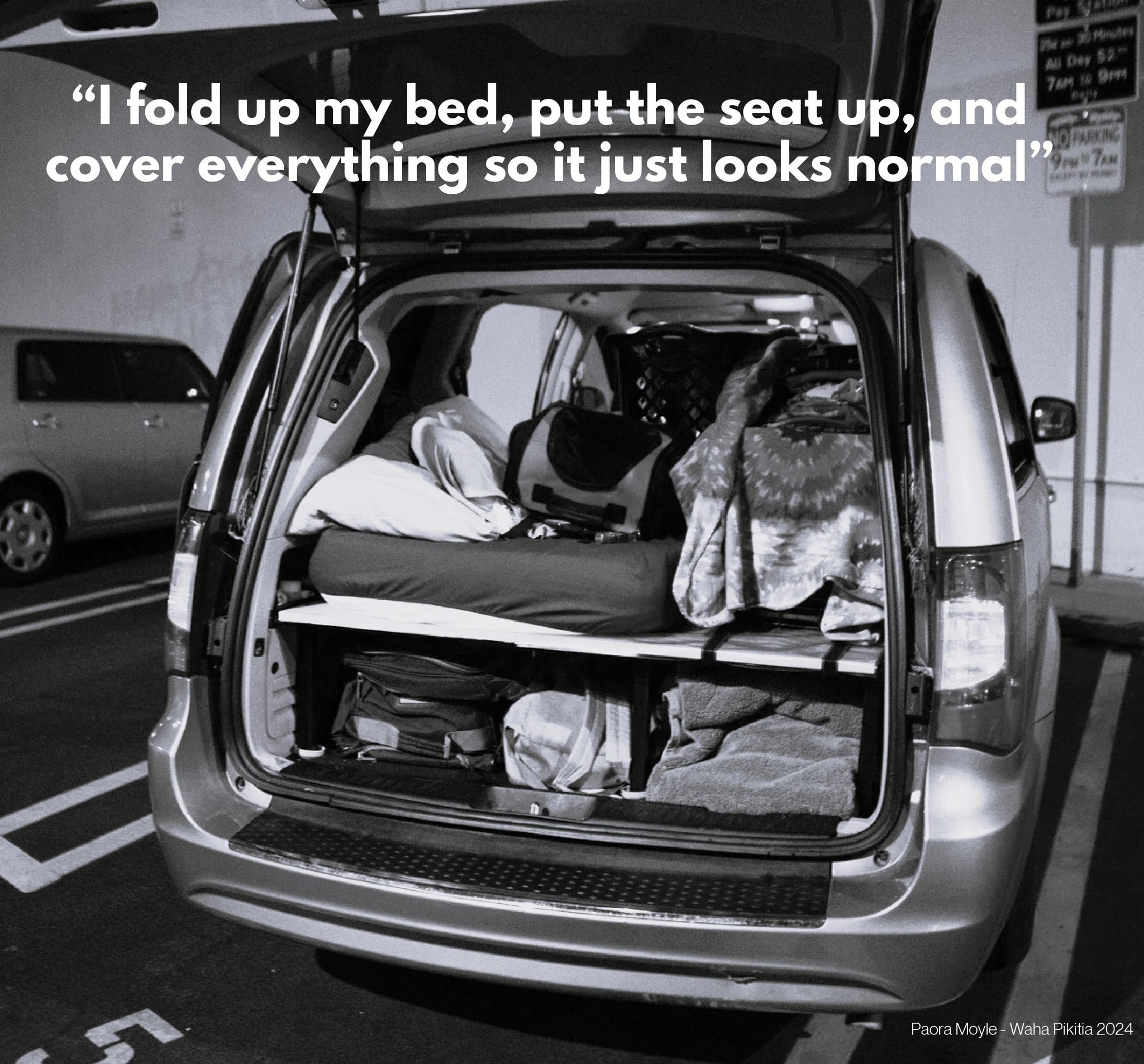
“A typical day [living in her car] I wake up at 5am because I’ve gotta go to the local [town] toilets to have a quick wash down with my flannel because they don’t have a shower up there…have a quick wash, brush my teeth, try and clean myself up, spray myself with perfume, go back to my car, and then have a snack bar for breakfast because I didn’t have dishes to carry around and stuff, fold up my bed, fold up my stuff – so everything looks normal. Put the seat up, cover everything so it just looks like I’ve come from my own house and go to work. Start there at 7:30, work 2 jobs. After work I go back to my car. That’s the daily routine.”
Gang Whānau Healing Intergenerational Trauma
Building on our initial research, Waha Pikitia was expanded in our ‘Gang Whānau Healing Intergenerational Trauma’ research. With consent, photography and video were used to capture participants’ lives in their own words and through their own lens. (When we first started the quality of the gear and videoing was not that great, but we have improved over time). These visual stories revealed how these whānau live, love, and exist in ways that textual descriptions alone could never convey. The visual documentation created a profound impact and was made available to the public, amplifying voices that too often go unheard.
Voices of Takatāpui Rainbow and MVPFAFF Survivors
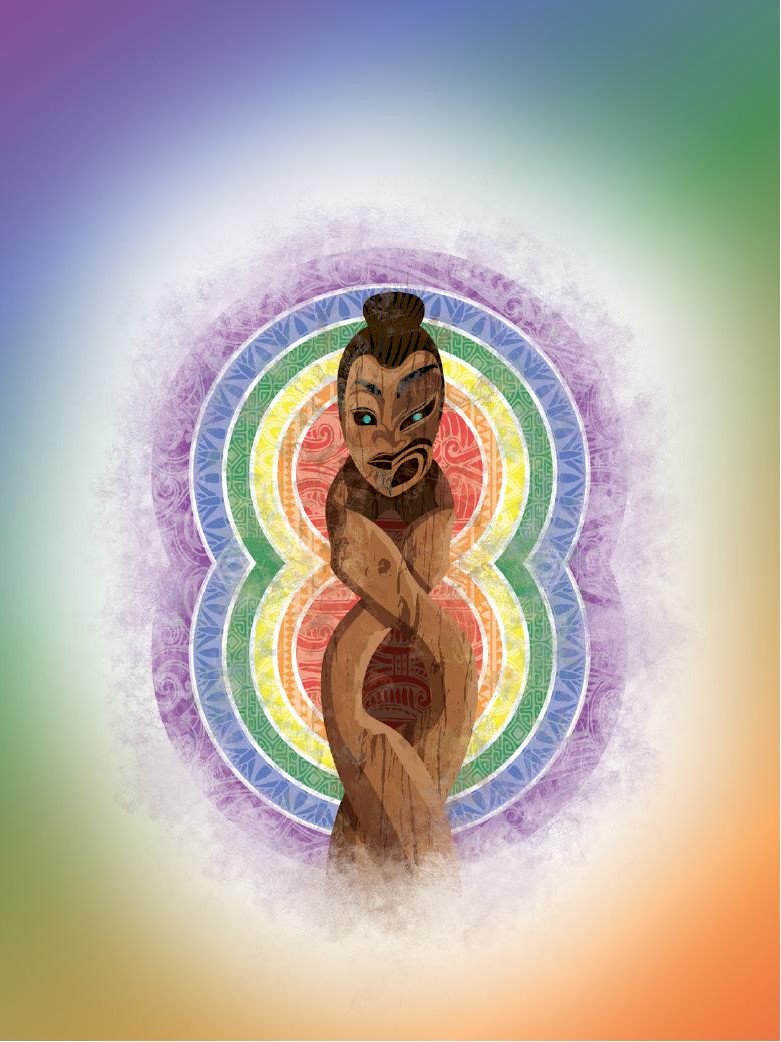
For the ‘Voices of Takatāpui Rainbow and MVPFAFF Survivors’ research, Waha Pikitia was elevated to a symbolic level by using a carving in our office to create an image that encapsulated everything the participants collectively conveyed.
The Pouwhenua was gifted to the front cover design of this report by Te Whāriki, symbolising our connection to the whenua and our tūpuna past. It stands as a tribute to story-sovereignty for both the participants and their whānau and mokopuna impacted by state and faith-based abuse in Aotearoa.
The Pikorua (twist) in the body represents the journey of our lives, the difficulties and celebrations, as well as the connection of people and the joining of different cultures. Complementing this, the multicultural rainbow behind the Pouwhenua holds space for all of this to occur. The two sides of the carved faces represent the eternal interweave and fluid nature of the sacred masculine (Whatukura) and feminine (Mareikura) energies.
This single, powerful image spoke volumes about identity, resilience, and collective healing.
Hauraki Māori Weathering Cyclone Gabrielle
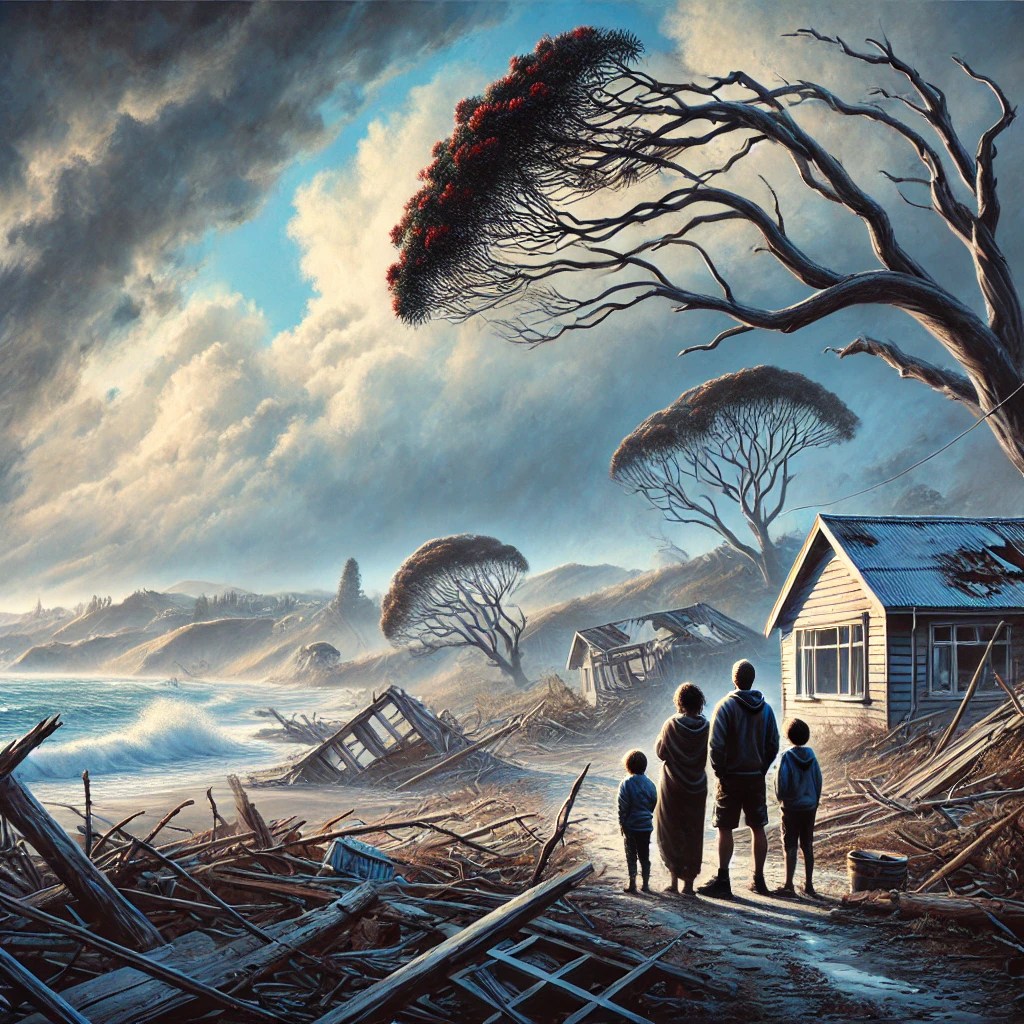
In the most recent research, ‘Hauraki Māori Weathering Cyclone Gabrielle,’ the application of Waha Pikitia expanded further. Photographs taken by participants and kaimahi were incorporated, alongside AI-created imagery that captured and expressed their pūrākau.
This approach demonstrated that Waha Pikitia is far more than just images that break up the typography of reports. It’s the participants’ visual expression of their pūrākau according to their own understanding and worldview.
More Than Just Pictures
Waha Pikitia transcends conventional research illustrations. It is a method that invites participants to co-create visual representations of their lived experiences. Through this process, they become active agents in how their stories are documented and shared, not merely subjects of research.
The practical application involves our team working alongside activity participants to photograph or graphically design images that they believe best communicate their experiences. For example, an image might capture the car, a motel they live in with a pair of child’s gumboots sitting outside the door, or their home in ruins, a simple yet powerful visual narrative of displacement and resilience.
![Wāhine spoke about being coerced into accepting the view by government agencies that Motel accommodation is an acceptable place for raising their tamariki and that more need to be built to solve the severe lack of housing. For example, “What the? You try bringing your whānau up in a motel unit.” They talked about government agencies and community services putting them down by using labels such as ‘homeless’ and ‘overcrowding.’ Those labels, they say, have come from the system using architectural designs suited to nuclear families, not tangata whenua and Pacifica whānau. Those labels, they say, are “…a ruse they [government] use to get Māori and Pacifica out of their homes”](https://pouhineresearch.nz/wp-content/uploads/2025/03/455499340_10233288012958426_1438969323550627163_n.jpg)
At Te Whāriki Manawāhine Research, we are committed to sharing our knowledge, tools, methods, and approaches. We design our capacity and capability around the needs of those who inspire us most, Hauraki whānau Māori who often experience the greatest hardship and are most excluded from being part of the solutions.
Through Waha Pikitia as a visual communication tool, we aim to create a research methodology that truly honours the voices, experiences, and wisdom of our communities. It is our contribution to transforming how research can serve as a vehicle for equity, inclusion, and positive change.
Paora Moyle (Ngāti Porou), is Director of Research at Te Whāriki Manawāhine Research. For more information about Te Whāriki Manawāhine O Hauraki and our work with Waha Pikitia, please visit our website or contact us directly.
References
Moyle, P. (2023). As a Kid, I Always Knew Who I was. Voices of Takatāpui, Rainbow, and MVPFAFF+ survivors: An independent research report provided to the Abuse in Care Royal Commission. Te Whariki Manawāhine Research. Thames, Aotearoa. https://www.abuseincare.org.nz/assets/Uploads/As-a-Kid-I-Always-Knew-Who-I-Was.pdf
Moyle, P., Kelly, L., & Messiter, D. (2024). Connecting Mahi Tūkino and Housing Poverty in Hauraki: Wāhine Give Voice to Compassionate Solutions. Te Whāriki Manawāhine Research. https://hauraki.refuge.co.nz/connecting-mahi-tukino-and-housing-poverty-in-hauraki-wahine-give-voice-to-compassionate-solutions/
Te Whāriki Manawāhine Research. (2024). He Whare, He Taonga Report. Te Whariki Manawāhine o Hauraki. Thames, Aotearoa. He-Whare-He-Taonga-FINAL.pdf
 POUHINE
You must be logged in to post a comment.