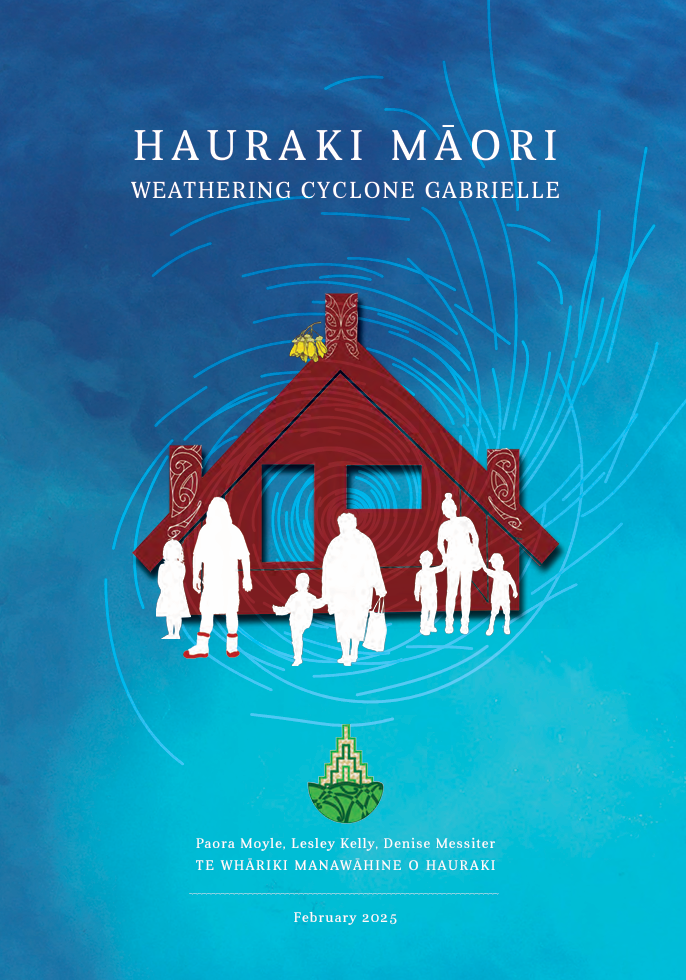
This week, our research “Hauraki Māori Weathering Cyclone Gabrielle” was presented as evidence to the Waitangi Tribunal’s Climate Change Priority Inquiry by CEO Denise Messiter of Te Whāriki Manawāhine O Hauraki. This marked the first public release of our findings since completing the Health Research Council-funded study in April this year.
What we documented during one of Aotearoa’s most devastating weather events isn’t new to Māori communities. It’s the same story being told across the country: the Crown’s systems fail us, so we create our own solutions. What makes this research significant is that it documents whānau implementing exactly the kind of constitutional framework that Matike Mai outlined in 2016. When authorities abandoned them, they had no choice but to prove how effective Māori-led governance actually is.
When “Civil Defence” Means Abandonment
“It began because they did nothing. I mean, seriously, absolutely nothing. We did our own emergency management planning.”
Those words, spoken by one of our research participants, cut straight to the heart of what happened when Cyclone Gabrielle slammed into Hauraki in February 2023. For 15 days, some of our most isolated communities were cut off, no power, roads blocked by slips. And critically, no support from the authorities supposedly responsible for keeping people safe.
But here’s what the official reports won’t tell you: within 6-12 hours, Hauraki Māori communities had activated their own emergency networks and were running disaster responses that put the government to shame.
How? They dusted off the coordination groups they’d built during COVID-19.
“So, there were things that were put in place and then when Gabrielle was coming… we just woke it up and we had the resources that we had there so we could get things in place quickly,” one participant explained.
While civil defence struggled with bureaucratic protocols, our people were already scanning their communities, identifying vulnerable whānau, coordinating food supplies, and setting up evacuation centres. They knew who needed dialysis, who required medication, who lived alone. They knew their whenua, their weather patterns, their people.
The Generator Scandal That Says Everything
Sometimes a single moment reveals the depth of systemic racism. Our research documented how a marae desperately needed a generator for displaced whānau. They asked civil defence. Sorry, none available.
The same day, a helicopter flew overhead carrying three generators to a wealthy, predominantly Pākehā community.
“We had to coordinate our own safety responses. So, we did it our way, we got food to people, we got emergency equipment and stuff for people. Because Council, apparently, couldn’t do it. It wasn’t safe,” one participant told us.
But it gets worse. When civil defence finally showed up at the evacuation centre that Hauraki whānau had established and were running perfectly well, they tried to commandeer the food and resources to redistribute to people they deemed more “deserving.”
As one participant put it: “It reeks of 21st century, well-tuned, well-willed institutional racism.”
Meanwhile, our houseless community were turned away from official centres. As one support worker recounted: “When they sought shelter, officials responded that they were not eligible because they were already sleeping rough. I understood this to mean that because they were already homeless, they were considered less deserving.”
During a humanitarian crisis. In Aotearoa. In 2023.
Centuries of Knowledge, Decades of Dismissal
What frustrated our research participants most wasn’t the resource disparities or even the racism; it was the frustrating ignorance of authorities who consistently dismissed their expertise.
“We’ve been reading these weather patterns for generations, but no one seems to listen when we warn about potential flooding,” one whānau member shared.
Another participant was more direct: “We’ve got eyes and ears on the ground. Essentially, we’ve got gumboots and raincoats on the ground, that can tell you what’s going on. The point is, if they had of listened to the locals, they would have been able to do something about it prior to all of that happening.”
This was climate negligence. Our research revealed a significant disconnect between the sophisticated environmental knowledge that Hauraki Māori carry and the one-size-fits-all approaches imposed by regional authorities who often don’t even live in the communities they’re supposed to serve.
“The utmost belief is that we know our people, we know what happens on our whenua before everybody else does. So, we don’t need people from external pushing a strategy. A one-size-fits all across everybody.”
The School That Became a Sanctuary
When official evacuation centres failed to materialise, our people didn’t wait for permission. They took over a local school and transformed it into a proper emergency centre that ran circles around anything civil defence managed.
“So, I think where we kind of come in was when we pretty well took over the [school] and had that as a civil defence. There was beds available there. We had the kitchen up and running. We were able to source extra bedding.”
But this wasn’t just about providing beds and kai. The manaakitanga was what you’d expect from whānau, but under extraordinary circumstances when they’d been completely abandoned by authorities. They set up separate areas for families and individuals. They cleared out a room for pets, because they understood that for many whānau, leaving beloved animals behind wasn’t an option. They provided extra support for a whānau with a loved one in a wheelchair. They found motel accommodation for an elderly couple and made sure food was delivered to them.
“Supporting whānau, you know, just making them feel comfortable, make sure they were warm and, had a beautiful place where they were and feeding them, you know, it didn’t matter who walked in the door.”
This is what disaster response looks like when it’s designed by people who actually understand the communities they’re serving.
From Shed to Home: Whānau-Led Solutions
Not everything in our research documents failure. The Hauraki Relocatable Housing Project shows what’s possible when you resource Māori communities to develop their own solutions.
Funded through partnerships with the Ministry of Housing and Urban Development, the project provided transitional housing for whānau whose homes were damaged by the cyclone. But navigating the bureaucratic maze of council compliance and land ownership issues required careful negotiations and considerable persistence.
“In the beginning, no, they weren’t helpful. We had pre-planned, had strategic meetings, and so to be fair, no, they were not helpful at all,” one participant said about dealing with Thames-Coromandel District Council.
The breakthrough moment came when one wāhine who had been living in a shed with no plumbing received her transitional home. The account still gives me chills:
“She wailed. She wailed. And when she could see the truck coming from the corner, till they’d landed, she just wailed, so that there was huge calling, calling herself home, and all her nieces… they all came there to tautoko her and they were wailing. And so, it was like, you’re at a tangi. It was, it was a real welcome home.”
This was about dignity, belonging, and the importance of being truly seen and valued by your community.
“It’s completely changed her life,” a support worker noted. And for another participant: “Thank god for [the organisation], thank god for leaders like her who show us we’re valued, worth something.”
The Blue Highway: Necessity Breeds Ingenuity
One of my favourite discoveries in our research was the concept of “blue highways.” Water-based evacuation routes that communities were planning to use when roads became impassable.
“Blue highways are boats on the water. Yeah, on the water. I love that term, blue highways. I should write a song about that.”
This is innovative disaster planning that recognises the realities of Hauraki’s geography and climate. Our people understand that when the next big weather event hits, they can’t rely on roads staying open or authorities having adequate transport. So they’re planning water-based evacuation routes using local knowledge of tides, currents, and safe harbours.
It’s exactly the kind of place-based thinking that should be informing regional disaster planning. Instead, it’s happening despite official planning, not because of it.
When the Dam Nearly Burst: The Koputauaki Crisis
Our research also documented the Koputauaki debris dam crisis, which perfectly illustrated the chaos that ensues when authorities lack adequate planning and community trust.
After Cyclone Gabrielle, a landslide blocked a gully above a Hauraki community, creating a debris dam that threatened serious flooding. The community was evacuated multiple times – four occasions in total, twice unnecessarily due to poor communication.
“So for the first week that went on, whānau were evacuated four times and twice unnecessarily by miscommunication, poor communication, no communication with the crew on the ground.”
Attempts to release water pressure by dropping water from helicopters were ineffective. “When you see the footage of the helicopter dropping monsoon buckets on the dam to part, it was like a spit in the ocean. It was not doing anything. It was huge.”
The repeated false alarms created a “boy who cried wolf” syndrome. Trust eroded. People stopped taking evacuation orders seriously.
“So then the whānau went home after one night. Nothing happened… And then, you know, we couldn’t sleep. None of us could sleep because of our whānau had gone back home. The risk was still up there.”
This is what happens when emergency management is designed by people who don’t live in the communities they’re supposed to protect, when there’s no meaningful relationship between authorities and residents, when planning is theoretical rather than grounded in local knowledge and trust.
The Methodology That Changes Everything
Our research used the Pū-Rā-Kā-Ū framework, which puts participant voices first instead of researcher interpretations. Rather than filtering community experiences through academic analysis, we let people tell their own stories in their own words.
This is decolonising research in action. Too often, research on Māori communities takes our knowledge without giving anything back or misrepresents our experiences through colonial frameworks.
Our approach ensures the wisdom and solutions come from the people who lived these experiences, not from outsiders imposing their own ideas.
Constitutional Transformation, Not Consultation
The solutions our research participants propose go far beyond consultation or co-governance. They’re calling for the constitutional change that Matike Mai outlined in 2016. Where Hauraki Māori have real decision-making power over emergency preparedness, where the Crown can’t override our responses, and where both work together as equals.
This is about implementing the framework that governments have ignored for ten years, despite now having proof it works.
Our participants want marae-based emergency management hubs recognised as critical infrastructure. They want amendments to the Local Government Act 2002 and Civil Defence Emergency Management Act 2002. They want barriers removed from the Building Act 2004 that prevent whānau from using papakāinga housing models in post-disaster recovery.
The Persistent Disadvantage Connection
Our research connects emergency management failures to what gets called “persistent disadvantage”, the ongoing barriers that keep Māori communities struggling.
Many whānau are “land-rich but cash-poor” due to historical land alienation. They live in substandard housing because building compliance costs are prohibitive. They face bureaucratic obstacles when trying to build on their own whenua. They’re excluded from decision-making processes that affect their lives.
Then when disaster strikes, these existing vulnerabilities are amplified. People living in garages and sheds are hit hardest by extreme weather. Whānau who can’t afford generators or emergency supplies suffer longer power outages. Communities that authorities already ignore get forgotten completely.
“Yeah, in one place there’s a cow shed that’s being made into a whare. There are several garages that have been made into whare. So, when it’s extreme weather events, they’re the people that are hurt the most.”
This is the predictable result of policies and systems designed to exclude Māori. Emergency management can’t be separated from housing policy, economic development, education, health, or any other area where systemic racism operates.
What Council Staff Actually Think
One of the most valuable aspects of our research was including Thames-Coromandel District Council personnel alongside community participants. Their insights were telling.
They acknowledged “historical trauma and mistrust” affecting Māori engagement with Council. They admitted their approach was often “process-driven and one-way instead of people-driven.” They recognised that “the relationship that has to help you through a bad emergency event, has to happen well before the event happens.”
Some were remarkably honest about the barriers: “I think a lot of like, small Māori communities especially, have historical trauma when it comes to dealing with councils, which has, in effect, made them less resilient and engaging.”
But they also revealed fundamental misconceptions. One suggested civil defence failures were partly because communities are too “reliant on people to be helped” and need to take more “self-responsibility.”
This completely misses the point. Our research shows Hauraki Māori communities are incredibly self-reliant. The problem isn’t a lack of self-responsibility; it’s a lack of resources, recognition, and respect for their existing capabilities.
The Trust Deficit
Perhaps the most destructive result of systemic racism in emergency management is the erosion of trust. Our research participants described feeling invisible to authorities, excluded from decision-making, and blamed for problems they didn’t create.
“Did they ask us what we thought might work, no! Two or three months down the track, they have all of these meetings. They’ve already made some plans. Hello? Did they talk to us? No.”
This isn’t just hurt feelings – it’s a genuine barrier to effective emergency response. When communities don’t trust authorities, they won’t follow evacuation orders. They won’t report problems. They won’t participate in planning processes.
Building trust requires more than better communication strategies. It requires acknowledging past failures, sharing real power, and consistently following through on commitments.
The Tribunal’s Constitutional Moment
The presentation of our research to the Climate Change Priority Inquiry represents more than an academic exercise. It’s a constitutional moment that could reshape how Aotearoa approaches both climate adaptation and disaster management.
The Tribunal must grapple with whether the Crown’s current approach to climate policy meets its Treaty obligations. Our research provides compelling evidence that it doesn’t.
The systematic exclusion of Māori from emergency management decisions, the dismissal of our ecological knowledge, the perpetuation of persistent disadvantage, the failure to protect our most vulnerable whānau – all of this points to fundamental Treaty breaches.
But more importantly, our research shows what’s possible when Māori communities are properly resourced and empowered to lead their own responses. We don’t need to be saved by the Crown; we need the Crown to stop taking up “look at me” space and just get out of our way.
This is what reclaiming Indigenous ecologies of love looks like in practice. This is what resilience actually means, not individual preparedness or government emergency kits, but communities that know how to care for each other.
The question for Aotearoa is whether our institutions can learn to work with these strengths rather than against them. Whether we can move from systems that abandon Māori communities to ones that centre our knowledge, respect our leadership, and resource our solutions.
Because this isn’t really about emergency management or even climate policy. It’s about whether Aotearoa will finally honour its founding promises or continue repeating the failures that leave our most vulnerable whānau weathering every storm alone.
Paora Moyle KSO is Director of Research at Te Whāriki Manawāhine O Hauraki and led the “Hauraki Māori Weathering Cyclone Gabrielle” research.
 POUHINE
You must be logged in to post a comment.